

Over the past two years, ISB has experienced rapid change and expansion towards its academic programs. Among these changes are a standards-based curriculum, a slew of AP courses part of the AP Capstone, and a new A-F grading system.
However, these developments raise several key questions: What motivated these changes in the first place? How will they impact students’ academic experience? And more importantly, how do the changes reflect ISB’s core identity?
Background
Before delving into the changes the school has undergone, it’s important to establish ISB’s history.
ISB opened in 1951 and was first founded to support the children of U.S Embassy staff and expatriates living in Bangkok. Later, the Vietnam War would lead to a surge in enrollment, with the expansion of the school’s academic programs and reputation continuing well into the 1980s. By 1992, ISB relocated to Nichada Thani, where it currently resides.

Nowadays, ISB is one of the best International schools in the world, with much of that owed to its rigorous academic programs—namely the International Baccalaureate (IB), which, in May 2024, 64% of students took.
However, it wasn’t always this way.
Back in the early 2000s, the school primarily offered ISB courses, with most students not taking IB or Advanced Placement (AP) classes. According to Daniel Sweeney, a World Studies teacher at ISB for 20 years, the IB diploma was offered, but taken by a select number of students. “The curriculum at that point was more tailored toward people going to North America,” Mr. Sweeney says. “[The IB Diploma] was there, but it was generally only kids going to Europe who were taking it.”
Additionally, ISB was sponsored by the American oil company Chevron, which led to a larger proportion of American students and faculty. Once Chevron stopped its sponsorship, the school began to emphasize the IB Diploma program. “It was the belief [by the Head of School and High School Principal at the time] that the IB diploma was a rigorous program and that our students were benefiting,” Mr. Sweeney says. He adds that in the 2010s, the school offered almost no AP classes. As a result, taking the IB Diploma became the “default,” as Mr. Sweeney puts it. This trend of the IB diploma being the “default” continued until 2021, with the addition of a few AP Classes.
Now, with former Head of School Sacha Heckmann at the helm for the past two years, ISB has undergone significant changes—the introduction of a new curriculum, AP courses, and grading system—all of which contribute to ISB’s ever-evolving identity as a school.
Standards-based Curriculum
One of the first changes implemented was a shift towards more standards-based learning in core subjects. A standards-based curriculum relies on teachers setting benchmarks for their students to reach by the end of a course. For instance, an essential learning standard that an English teacher might use is that by the end of a unit, a student should be able to cite textual evidence to support their analysis. While teachers naturally establish goals for their students to meet, a standards-based curriculum makes those objectives more specific.
In an interview before his resignation, Dr. Heckmann stated that the main goal was to make the skills students are expected to learn clearer.
“We, as an institution, have to decide what the minimum level of proficiency is that we would expect from students to deem them an ISB graduate, and that’s a really contextual decision,” Dr. Heckmann says. He continues by explaining that when he first arrived at the school, students had trouble understanding the work needed to achieve each grade in the 1-7 numbered grading system. Which, in turn, made the path to reaching higher bands unclear. “Standards-based movement is really about the clarity of expectations,” Dr. Heckmann says. “And that’s being able to communicate effectively…how we decide what is a 5, what is a 6, what is a 7.”
As it stands, Mr. Sweeney admits that it’s “too early to tell” what effect the standards-based curriculum will have on student achievement and learning.
AP Capstone
Another major change has been the addition of the AP Capstone. In the 2022-2023 school year, ISB only offered two pathways: the IB Diploma and the Personal Choice Diploma. The Personal Choice Diploma gave you access to IB, ISB, and AP courses, although only six AP options were available at the time. The next year, the AP Capstone was added. The AP Capstone requires students to take six AP classes and obtain a minimum score of three on their final exams.
Currently, students can choose from 20 AP courses; three times the number of AP courses a student could have taken three years ago.
Dr. Heckmann asserts that the goal of the AP Capstone is to give students more choice. “I think giving kids’ choice should always be at the center of what we do because not every kid’s path should be the same,” he says. “And so what we aim to do by bringing the AP curriculum back is providing another way for kids to attain their goals while maintaining a strong IB program.”
He also strongly believes that the idea of the AP being an inherently American system is “dated,” and cites another international school, Singapore American School (SAS), as an example of the AP’s global reach. “SAS only offers AP, and they send kids all over the world and have as diverse college matriculation as we do,” he says. He also mentions that many British universities, such as the University College London (UCL), can calibrate AP scores to equivalent IB scores. “To get into UCL, you have to have an overall 40 or higher [IB score],” Dr. Heckmann says. “And they correlate that to getting a [score of] 5 on five AP exams.”
When it comes to university admissions, Director of ISB University Counseling, Curt Nichols, says that “virtually every university in the world knows about AP, understands it, and will have some sort of requirement [available for AP students].” Mr. Nichols, who worked as a freshman admissions reader at the University of California, Berkeley (UC Berkeley), says that both systems, especially in the U.S, are accepted and well-regarded. “[Admission officers] can’t short-change students who didn’t have [access to certain education systems].”
Despite this, Mr. Nichols does admit that the IB is “a little bit more internationally recognized [compared to the AP]” and that “there are some places where IB is going to be the fail-safe route.” For example, studying in certain European countries, such as Germany, will likely require a student to take the IB rather than the AP, as it’s the most recognizable system.
Where the two programs truly differ is in their purpose and course structure. Mr. Sweeney, who has taught both the AP and IB, explains that “the IB was created to allow international students to go to European universities…the AP, on the other hand, was created with a different purpose…it was created to offer high school students the chance to earn college credit at U.S. universities.” Additionally, IB classes cover material in depth over two years, while AP courses focus on learning a breadth of information in a year. According to Mr. Nichols, at UC Berkeley they saw “a one-year AP course [as] equivalent to a one year of an IB higher level class.”
As a result of these differences, the school is attempting to provide “more opportunity for success,” by introducing the AP, says Mr. Nichols. “Whereas the IB diploma may not have been a good path for a student, or it would have been an excruciating two years….now they can enjoy high school, do well, find success, and still have really good university options [with the AP program].”
Dr. Heckmann also says ISB considers where students enroll to help guide their decisions. “What we need to start thinking about is how we amplify our students,” he says. “Over 900 of our applications last year went to the United States and…120 went to the U.K., and both of those systems [U.K. and U.S] accept either program.”
Still, there are concerns about the rapid implementation of AP classes and the larger effect it’ll have on students. “There is a limit to the number of courses that we can eventually offer,” Mr. Sweeney says.“Our departments can get drawn pretty thin.” He mentions that the change also affects the number of students in each course. “It’s possible that in the future we may have to reduce our IB offerings or reduce our AP offerings because we’re not getting enough students to justify both an AP and an IB class [that teaches the same subject].”
Senior Karan Nugroho, an IB student who is not applying to the U.S, believes that ISB should remember the needs of all students. “I know that our school is already kind of based in America,” she says. “But I think it’s still important to consider the whole [student body]…not everyone is going to be using the American system, and this change is mostly for them.”
There is no doubt that the AP Capstone will benefit students who plan to attend U.S. universities, giving them more choice in the type of classes they take. Nevertheless, the shift to the AP represents ISB’s desire to “amplify” student admissions, especially in the U.S, where college admissions continue to become more competitive every year.
New Grading System
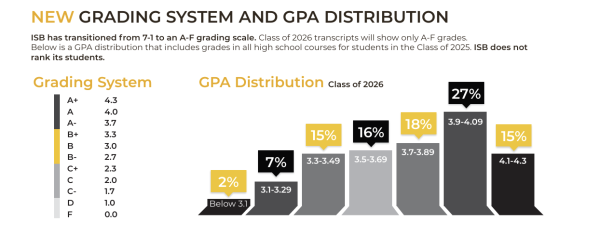
The latest change ISB has implemented is the new grading system. Previously, the high school operated on a 1-7 grading system, similar to the IB. Now, ISB utilizes an A-F system, moving from a 7.0 scale to a 4.3 scale. This is generally more in line with North American reporting standards.
Last year, PantherNation interviewed Mr. Nichols about the change. Mr. Nichols notes that the change was made to align the overall grading system, as the school offers IB, AP, and ISB courses; all of which use different grading scales. With the return to the A-F system, the school is now making the system “neutral,” according to Mr. Nichols.
With the new system, the calibration from the 1-7 scale to letter grades has sparked discussions of grade inflation, as number grades such as 4 or 3 are calculated to C+/B- and C-/C on the letter scale.
When asked about whether the new grading system inflates grades, Dr. Heckmann says that he doesn’t “think of it in that way.” Instead, he sees it through the lens of a “litmus test,” in which how a student does in university should reflect how much their high school prepared them. “Grades are a representation of your academic preparation for the next step,” he says.
Dr. Heckmann further explains how he views high school grades and university: “If you’re well prepared for the next step, that means our grades were accurate because it got you into a certain university, and that university is…appropriately challenging for you. It shouldn’t be easy. You should not step into university and see it as easy. Too many of our alumni are saying, ‘university wasn’t that tough.’”
As a result, Dr. Heckmann doesn’t see the grade system as inflating grades; instead, ISB is correlating grades to a student’s achievement relative to the universities they are applying to. “The transition to university should be harder than your senior year. And if it’s not, then maybe we were not grading you generously enough.”
Another interesting point about the change is that it isn’t the first time the school has used a letter-based grading system. According to Mr. Sweeney, when the school first switched to a 1-7 scale, during the increased push for the IB, the justification was that “kids get too caught up in the difference between B-, B, or B+. They see those as significantly different.” To the Head of School at the time, the 1-7 grading scale mitigated these problems by clearly differentiating each band without including minuses or pluses.
Now, a similar rationale is being used for returning to an A-F grading system. “I don’t think that people [like university partners, parents, and students] truly understand the effort it fully takes to get a 7,” Dr. Heckmann says. “Whereas an A+ is something people understand…likewise, we would argue that getting a 6 is being really well prepared, which is the equivalent of an A.” He ends by saying, “we’re trying to create a universal communication system across a variety of programs that’s clear to…parents, students, and our outside partners like universities.”
As part of creating a “universal communication system,” the way ISB students are presented to universities now differs. In ISB’s high school profile, a document sent to colleges to provide the school’s context, grading system, and demographics, ISB students weren’t represented well when the 1-7 grading system was used. “We had a really poor high school profile,” says Mr. Nichols, “It was not savvy, and it didn’t really help admissions.”
He explains that before the new grading system, the high school profile displayed the percentages of 7s, 6s, 5s, etc., achieved across the entire high school. “If I’m an admissions person… I’m just going to assume that’s across the board [for every grade level],” he says, “but the number of 7s in grade 11 and 12 was significantly lower than what we were reporting.”
Now, though, this problem is fixed. With the new 4.3 grading scale, ISB’s high school profile now displays the distribution of GPAs achieved, which makes where a student falls clearer to admissions officers and “provides more integrity,” according to Mr. Nichols.
“Someone could say [the new system] is inflating grades a little bit, I prefer to call it shifting the GPA distribution,” Mr. Nichols says. “If you look at the landscape of the world right now, the grade inflation is really epidemic. I don’t know a school that hasn’t shifted its grade distribution.”
For Mr. Nichols, he interprets the admissions process as a game: “There is some strategy involved…If you’re the school that’s really harsh on your grades, then you’re going to lose, right?… If you asked me if I supported that [change to the grading system], absolutely I did, 100%. I wanted our kids to be more successful in the game.” And ISB’s admissions record indeed is “significantly better,” which Mr. Nichols not only credits to the change, but to the students.
The larger issue with a change this massive is the transition period. Mr. Sweeney recalls that when the school first switched to a 1-7 grading system, teachers had trouble adjusting as they were more familiar with the A-F system; now the opposite seems to be true. “We hired so many teachers predominantly because of their experience in the IB. For some of them, that’s the only grading system they’ve learned,” he says. Mr. Sweeney adds that “the two scales don’t convert very easily from one to the other,” and that questions such as “why is this a B versus a B+ versus an A- ?” will likely remain despite ISB’s desire to make the grading system clearer.
ISB’s Identity
With all these swift changes to the school, the question of how this will affect the ISB’s identity remains.
For instance, recent hiring practices seem to be more skewed towards American teachers. According to ISB’s Human Resources department, of the 35 teachers hired for the 2025-2026 school year, 21 are Americans. That is a 60% majority at a school where a large proportion of teachers are already American. The reason for these hires, according to Dr. Heckmann, was to find people who were familiar with a standards curriculum and teaching AP courses.
Teachers like Mr. Sweeney believe that the AP Capstone will affect the school’s overall identity. “To me, the identity of the school is made up of the people that work there and the student body that goes here,” he says. “If we add more AP courses, and that requires more American teachers, then the faculty may become, once again, more Americanized…I don’t see that necessarily happening with the student body, [it’s] quite diverse.”
On the topic of teacher diversity, Dr. Heckmann reasons that “as an American school, you’d always expect that probably more than 50% of your teachers would come from that background.”
When asked about being an American school, Dr. Heckmann believes that, despite being named the International School Bangkok, we are at our core an American school. “Historically, when we look at what our identity is, being founded by the US Embassy, having nine of our ten previously adopted curriculum areas being US-based, that would imply to me that we are an American school.”
Dr. Heckmann further clarifies by explaining that ISB is an “American school that serves an international population with a global outlook,” more akin to Singapore American School or Taipei American School.
The addition of the AP Capstone and new grading system only uplifts this idea. Both practices are more common in North America and signal the school’s desire to appear more favorably towards U.S universities.
It’s important to note that, despite having a North American curriculum and being founded by the U.S Embassy, ISB has always been steadfast in its identity as an international school, at least when it comes to its student body, which comprises more than 60 nationalities.
Additionally, ISB is well-known for its relationship with the local Thai community. Mr. Sweeney says that as the school has changed over the past 20 years, this aspect has been lost. “ISB’s connection with the Thai community was more significant when I [first] came,” he says, “We had a lot more direct service projects where people actually went out [to help the local] Thai community. We had a lot more teachers who were spouses of Thai or were Thai. We had a lot more Thai language [integrated in the school].”
While Thai students continue to make up a large proportion of the student body (about 27% according to ISB’s high school profile), ISB’s direct involvement with the wider Thai community is weaker. “Yes, we had a North American curriculum…But I always felt that there was a bigger connection [between ISB and the Thai community],” Mr. Sweeney says, “I just think things change over time…we still have it [that connection], but perhaps it’s not as strong.”
Regardless, Mr. Sweeney still believes ISB upholds an international outlook through the IB program. “One of the great things about ISB is the international character of the students, and the outlook of the faculty…our curriculum through the IB is much more international in perspective than it would be if we were [only an] American school.”
Though with how the school is moving with AP classes, one can only question how large a presence the IB will have in the following years.
Zach Hall, a senior who takes the IB diploma, thinks the new changes will certainly result in a different experience. “The overall experience that we [seniors] are getting out of ISB will be very different from a current grade nine student who goes through all four years. I think it will be a lot more AP focused,” he says. “We are sliding towards a more American school, especially on the student side of things.”






gigi • Mar 10, 2026 at 9:02 pm
ABSOLUTE FIRE 🔥🔥🔥 hopefully we don’t lose our international identity because of this!! Please feed us more articles like this, Panther Nation, we’re begging!! ❤️❤️❤️
Zach Hall • Mar 10, 2026 at 8:58 pm
A fascinating deep dive on a topic close to all of us. More of the same please Panther Nation!
Mindy • Mar 10, 2026 at 8:50 pm
banger article bro please save us panther nation